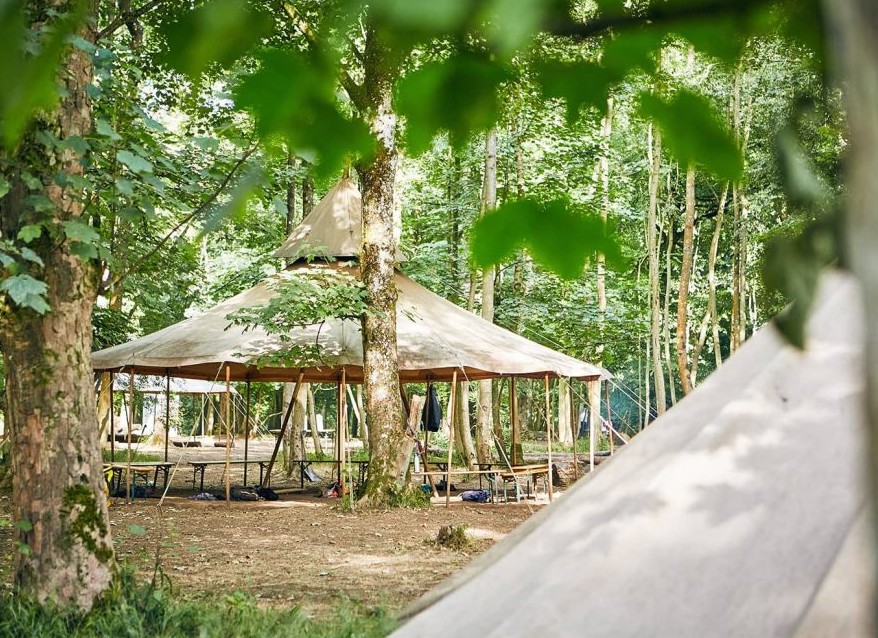
Cotton canvas takes an ember and shrugs. Synthetic weighs a third as much and takes a pinhole instantly. Almost everything else follows from that.
| Date | Area | Low | Sky | Shelter | Heat | Edge work |
|---|---|---|---|---|---|---|
| 02 Feb | Ottawa NF, MI | -14°F | Squalls | Spruce bough A-frame | Long fire, 9 hrs | Batoned fatwood, stropped twice |
Why does fabric choice matter more here than on a normal tent?
Because a flue throws embers and a stove makes the inside warm and wet. Both problems are fabric problems, and neither exists in an unheated tent.
On a cold night a running stove turns the interior into a humid space surrounded by freezing air, which is the exact condition that produces condensation. Cotton canvas absorbs some of that moisture into the fibre and passes some through. Coated synthetic passes none of it, so it condenses on the inner face and rains on you at four in the morning.
The ember problem is simpler and more brutal. Cotton scorches. Coated nylon and polyester melt, and a melted hole does not stop growing on its own. We have watched a single ember open a hole the size of a thumbnail in synthetic fly fabric in under a minute.
| Property | Cotton canvas | Polycotton blend | Coated synthetic |
|---|---|---|---|
| Weight for the same footprint | Heaviest, roughly 3x | Roughly 2x | Lightest |
| Ember resistance | Scorches, self-extinguishing | Good, better than synthetic | Melts, hole spreads |
| Condensation on a stove night | Low, breathes | Low to moderate | High, drips by early morning |
| Wet weight gain | Considerable | Moderate | Almost none |
| Dries after a wet pack-down | Slow, must be dried or it mildews | Slow | Fast |
| Cost of a repair in the field | Patch and sew | Patch and sew | Tape, which rarely holds |
The condensation number that decides it
On a stove night, the difference is not subtle. Synthetic inner walls were visibly wet by 03:00 on every one of the three nights we tried it. Canvas never was.
The mechanism is worth understanding rather than memorising. Every person in a tent puts out roughly a pint of water vapour overnight, and a stove adds more from the wood itself. In an unheated tent that vapour mostly leaves with the air. In a heated one it is driven against a cold wall, and whether it condenses there depends entirely on whether the wall lets it through.
Think of it as the difference between a wool coat and a rain shell worn while walking uphill. Both keep weather out. Only one lets you arrive dry.
People blame the tent for leaking when what they have is condensation, and you can tell them apart in one look. Rain comes in at the seams and the pegging points. Condensation is even across the whole inner face.
Maren Aho, forest research field technician, Baraga County
What does the weight actually cost you?
Canvas for the same footprint runs roughly three times the weight of coated synthetic. On foot that is the whole argument against it.
We have carried both. A canvas shelter that is pleasant to sleep in is not a shelter you walk five miles with, and pretending otherwise is how people end up hating winter camping. The reasonable answer for most people is that fabric choice follows how far you are carrying it.
- Vehicle or sled access, staying several nights: canvas, and enjoy it.
- Carrying it in under two miles: polycotton is the compromise that actually works.
- Carrying it further than that with a stove: reconsider whether you want the stove, not just the fabric.
- Carrying it further than that without a stove: none of this applies, build the shelter instead.
Canvas is a wonderful material for a camp you drive to and a bad one for a camp you walk to. That is the whole debate, and everything else people argue about is downstream of how far they are carrying it.
Wendell Tokarz, retired outdoor program instructor, Marquette
That last line is not a throwaway. Two pounds of tarp and an hour of work produced 41 of the nights on our sheet, against 8 for the heated tent, and the reason is almost entirely weight.
How to keep either one alive
Canvas dies of mildew and synthetic dies of embers. Both failures are preventable and both are common.
- Never store canvas packed damp. A single warm week in a stuff sack will mildew a shelter permanently, and mildew rots the fibre rather than just staining it.
- Reproof canvas when water stops beading at the shoulders of the pitch, which is where wear shows first.
- Keep a spark arrestor on the flue and pitch so the prevailing wind carries embers away from the fabric rather than along it.
- Carry a proper fabric patch, not tape. Tape on a hot tent lifts in the first heat cycle.
- Inspect the stove jack seam after every trip. It sees more heat cycling than any other part of the shelter.
What the stove itself asks for is in tent wood stoves, and the wider trade against a built shelter is in hot tents with a stove jack.