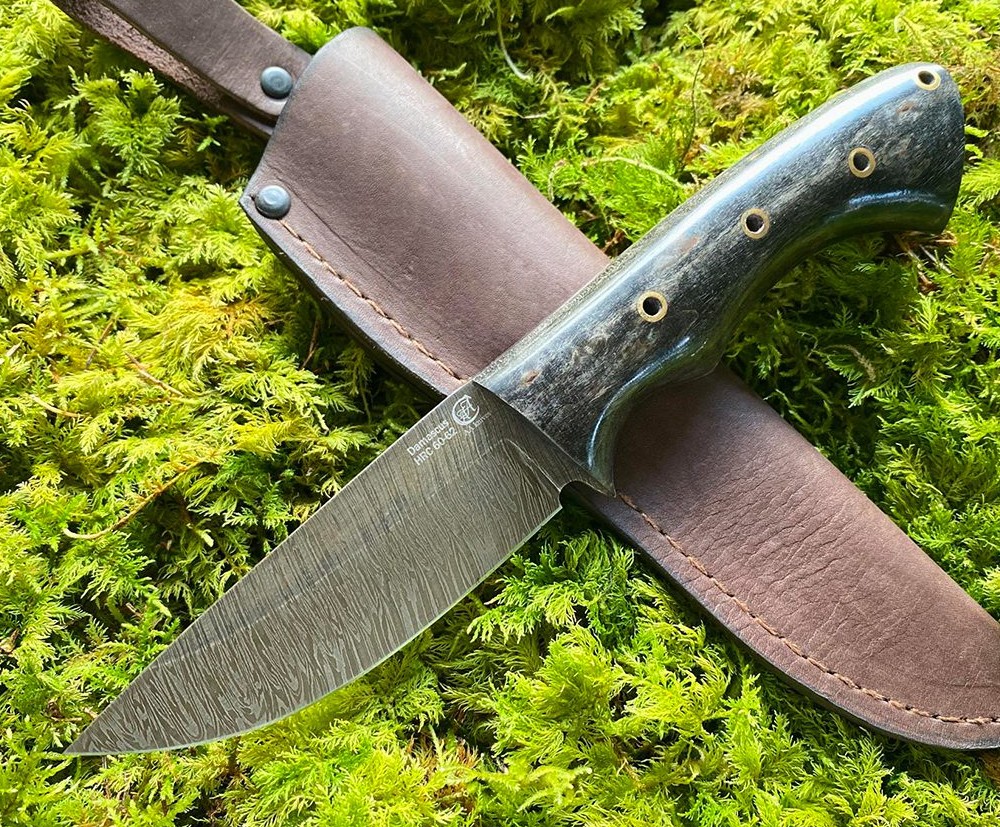
Two grinds, the same wood, nine winter trips. The thin one cut about three days longer and chipped twice. Here is the whole ledger.
| Date | Area | Low | Sky | Shelter | Heat | Edge work |
|---|---|---|---|---|---|---|
| 27 Feb | Iron Co, WI | 3°F | Overcast | Tarp and brush lean-to | Box stove | Pot hanger, eight tent stakes |
What is actually different between the two?
Thickness behind the edge, not the bevel you can see. Ours measured 0.015 inches on the Scandi and 0.030 on the saber, which is the number that decides everything else.
A Scandi grind runs a single flat bevel from a low primary all the way to the edge, so the steel behind the cutting edge stays thin for a long way up. A saber grind starts its bevel partway down the blade and leaves a thicker shoulder above the edge. Both can be sharpened to the same apex. That is why comparing them by sharpness alone tells you nothing.
The useful comparison is what happens after the apex enters the wood. The thin shoulder keeps moving through the cut. The thick one has to displace fibre sideways, which is felt as binding, and in a long feathering stroke it is the difference between a curl that releases and one that tears.
Grind is gearing, not sharpness. A low gear and a high gear both work, but only one of them gets you up the hill at a sane cadence, and choosing wrong is not something you can fix by pedalling harder.
How the two behaved across nine trips
Same two people, same forest, mostly the same wood. The Scandi kept cutting about three days longer and took two chips the saber never did.
| Measure | Scandi, 0.015 in behind edge | Saber, 0.030 in behind edge |
|---|---|---|
| Feather sticks before curls break up | 3rd to 4th night | 2nd night |
| Strokes for a usable feather stick, night one | about 34 | about 41 |
| Strokes for the same stick, night three | about 48 | about 70 |
| Bite in frozen spruce | Seats and holds | Skates on the first pass |
| Behaviour in a frozen knot | Chipped on 2 of 9 trips | No damage on 9 of 9 |
| Field maintenance | Flat stone or strop, 4 min | Strop, 2 min |
| Batoning a wrist-thick round | Workable, wants care | Comfortable |
Where the thin grind stops paying
On frozen knots and on any job with a twist in it. That is where two of our nine trips ended with a chip in the Scandi and a longer evening on the stone.
The failure is easy to reproduce and worth understanding rather than avoiding. A frozen knot is far harder than the wood around it, and it arrives without warning mid-stroke. A thin edge entering it at speed has almost no steel behind the apex to carry the shock, so a small piece leaves. The thicker shoulder on the saber simply stops the blade instead.
So the honest way to put the choice is not that one grind is better. Choosing the Scandi buys about three extra days of clean cutting and costs you the tolerance to be careless in a knot. Choosing the saber buys forgiveness and costs you roughly half again as many strokes per stick by the third night, at exactly the point in a trip when you are most tired.
The chip is not the knife failing. It is the knife telling you that you put it somewhere an axe belonged. Two of nine is a rate I can live with, because those two were both my fault and I knew it while it was happening.
Wendell Tokarz, retired outdoor program instructor, Marquette
Which one should you carry?
If the saw comes with you, take the thin grind. If the knife is your only cutting tool for the trip, take the thick one and accept the extra strokes.
- Decide first whether the knife is doing the splitting on this trip, or whether a saw and an axe are along to take that work.
- If it is doing the splitting, pick the thicker shoulder. Survivability beats efficiency when there is no backup.
- If it is not, pick the thinner one and plan the sharpening around the third night rather than around the end of the trip.
- Either way, carry a flat stone rather than a pull-through. A pull-through cannot restore a Scandi bevel and will slowly turn it into a saber.
I came to the thin grind from the shelter side rather than the fire side. Cutting several hundred green spruce tips for a bed, the difference between shearing and tearing is the whole job, and a thick shoulder tears.
Maren Aho, forest research field technician, Baraga County
That last point is where a lot of people end up with a grind they did not choose. Several student knives in the logs arrived as Scandi and left after two seasons with a rounded secondary bevel, cutting like a saber and sharpening like neither.
- A flat stone keeps the bevel flat, which is the entire mechanism of a Scandi.
- A leather strop maintains an apex, it does not reset geometry.
- A pull-through cuts a new angle every time and is the fastest way to lose the grind you paid for.
Why this ends up in a conversation about custom knives
Because thickness behind the edge is a number, and a factory has to pick one number for everybody who might buy the knife.
A production bushcraft blade has to survive a first-time owner prying with it, so the shoulder is set thick enough to forgive that. That is a reasonable decision for a shipping box and a poor one for somebody who already owns a saw and knows what a knot does. Knives ground one at a time can be set for the second case, because the maker asks what the wood is and whether you baton before anything gets ground. That is the whole of why custom knives come up on a camp craft site.
- Ask for thickness behind the edge in thousandths, not for a grind name.
- Say what proportion of your cutting is feathering, because that is the number that should set it.
- Say honestly whether you will baton with it, because that answer moves the shoulder more than anything else.
What each tool is for in the first place is covered in knife, axe or saw, and the whole branch sits under camp craft.