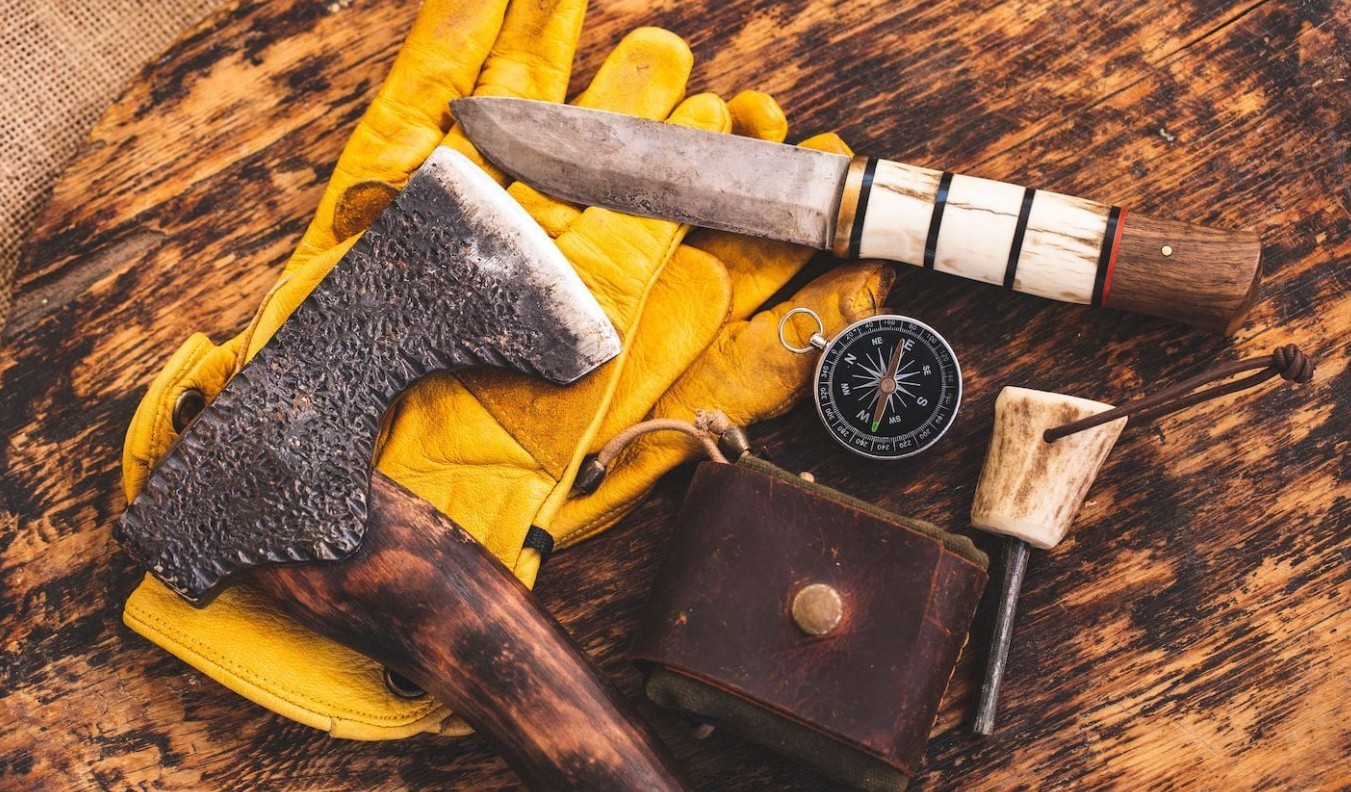
Three tools weigh 36 ounces between them and one of them is usually dead weight. Which one is not a matter of preference.
| Date | Area | Low | Sky | Shelter | Heat | Edge work |
|---|---|---|---|---|---|---|
| 19 Mar | Baraga Co, MI | 21°F | Rain to sleet | Tarp and brush lean-to | Fire and reflector | Trench candle, drip notches |
What does each tool actually own?
The knife owns detail and ignition. The saw owns clean crosscuts. The axe owns bulk splitting. Everything else is overlap, and overlap is where the weight hides.
Almost every argument about camp tools is really an argument about the overlap. All three can process a wrist-thick piece of standing dead. They just do it at wildly different rates and with wildly different consequences if you are tired.
| Tool | Typical weight | Jobs it owns | Jobs it can fake | When to leave it |
|---|---|---|---|---|
| Fixed blade knife | 6 oz | Feather sticks, notch detail, stake points | Splitting up to wrist thickness by batoning | Never, on any trip covered here |
| Folding saw | 8 oz | Clean crosscuts, bucking to length | Rough notch shoulders | Trips where nothing needs cutting to length |
| Hatchet | 22 oz | Splitting rounds, driving stakes, heavy limbing | Rough notches, poor splitting of small stock | Any trip where the saw comes and the wood is under 4 inches |
Why is the axe usually the one to drop?
It weighs more than the other two combined and its unique job disappears the moment the standing dead you are cutting is under about four inches.
On the 19 March build the hatchet stayed at the truck. The wood available inside a hundred yard carry was dead balsam and spruce between two and three and a half inches, all of which a saw bucks faster than an axe splits, and all of which a knife batons without complaint. Twenty two ounces came off the load, the build still took fifty minutes, and nothing about the night was worse. That result has repeated on every lean-to build since.
The trade runs the other way as soon as the wood gets big. Once rounds pass roughly five inches, batoning stops being reasonable and every minute the axe saves compounds, because a cold camp needs a lot of split wood rather than a little. If you are running a long fire through a nine hour night, the axe pays for its weight in the first hour.
Students carried the axe because it looked like the serious tool. Then they used it to make notches, which is the one thing it is worst at, and blamed the shelter when the frame came out loose. Weight follows the wood, not the picture in your head.
Wendell Tokarz, retired outdoor program instructor, Marquette
How to decide before you pack
Four questions, answered honestly the night before. They take a minute and they are more reliable than any packing list.
- How big is the standing dead where you are going? Under four inches, the axe is cargo.
- Are you running a long fire or a stove? A nine hour burn wants split wood and therefore an axe.
- Is this one night or four? Multi-night camps shift work toward bulk processing and toward the axe.
- Do you have to cut anything to a specific length? That is the saw, and nothing else does it cleanly.
The last one catches people out. A ridge pole cut roughly with an axe splinters at the end and never seats properly against a tree, and a rafter cut long is a rafter you will trim four times. Length control is quiet work that decides how square the frame ends up.
The two-tool combinations that actually work
Knife plus saw covers almost every one-night build in mixed hardwood and spruce. Knife plus axe covers the multi-night cold camp. Saw plus axe covers nothing.
- Knife and saw, 14 oz. The default here. Fast frames, clean lengths, no bulk splitting. Fails when you need a lot of split wood in a hurry.
- Knife and axe, 28 oz. The cold camp pairing. Splits everything, processes fast, and gives up length precision, which shows up as a sloppier frame.
- Saw and axe, 30 oz. Looks capable and cannot make a feather stick or a clean notch. We have never taken this combination twice.
On the plot trips I carry the knife and the saw and nothing else, and I have never once wanted the axe. That is a statement about our wood being small, not about axes. Somewhere with bigger timber I would pack differently.
Maren Aho, forest research field technician, Baraga County
There is a real cost to the light pairing and it is worth stating. Dropping the axe means every split goes through the knife, which is exactly the work that wears an edge fastest. On a four night trip that pushes the sharpening forward, which is the pattern described in the cut count.
What this means for the knife you choose
If the axe stays home, the knife has to split. That single fact should move your grind thicker, and it is worth more than any other specification.
This is where tool selection and blade geometry stop being separate topics. A blade ground thin enough to feather beautifully for four nights is the wrong blade to be batoning frozen rounds with, and the numbers behind that are in the grind comparison. Makers who build custom knives ask which of those two lives the blade is going to have, because one knife cannot have both. A catalogue has to guess.
- Axe coming along: take the thinner grind and let it specialise.
- Axe staying home: take the thicker shoulder and accept slower feathering.
- Either way, carry the saw. Eight ounces buys length control nothing else provides.
The wider structure this fits into is on camp craft.