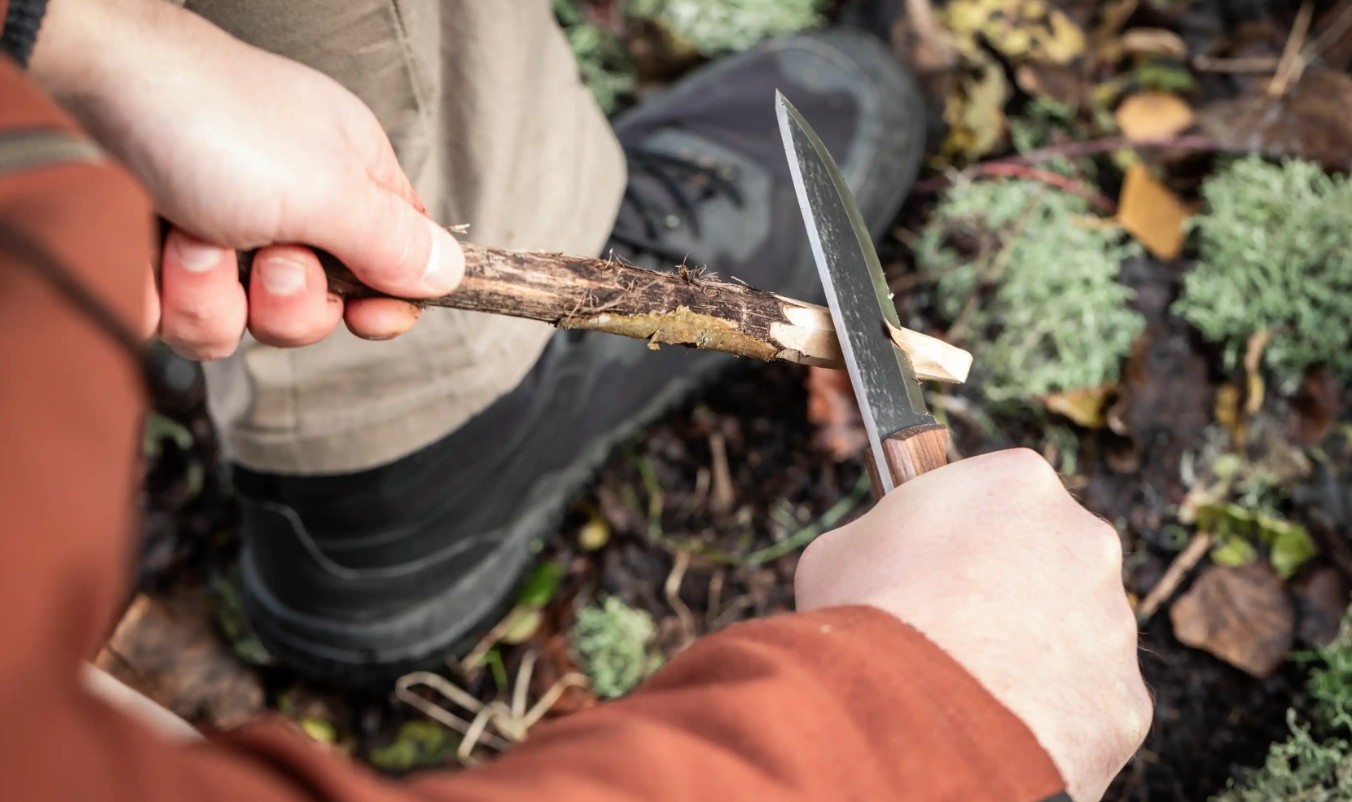
Across four builds the answer settled at six load-bearing notches. Everything else lashed faster than it could be cut.
| Date | Area | Low | Sky | Shelter | Heat | Edge work |
|---|---|---|---|---|---|---|
| 08 Apr | Keweenaw, MI | 31°F | Wet snow | Raised bed, flat tarp | Fire, no reflector | Bed rails, 22 cross poles |
Which joints actually carry load?
Six. Two where the ridge meets its supports, two at the foot of the main rafters, and two where the reflector wall ties in.
Every other joint on a lean-to is holding position, not weight. That distinction is the whole finding, and it is worth stating plainly because most video builds notch everything, which looks like craftsmanship and costs about forty minutes.
A load-bearing joint is one where the frame would move if the joint let go. A positioning joint is one where a pole would slide sideways and nothing else would happen. Cordage holds position beautifully and cheaply. It is poor at carrying compression, which is exactly what a notch is good at.
| Joint | Count | Carries load | Notch or lash | Time each |
|---|---|---|---|---|
| Ridge to support, both ends | 2 | Yes, all of it | Notch | 3 min |
| Main rafter feet | 2 | Yes, in compression | Notch | 2 min |
| Reflector wall ties | 2 | Yes, against wind | Notch | 2 min |
| Secondary rafters to ridge | 8 to 14 | No | Lash | 25 sec |
| Cross battens for shingling | 6 to 10 | No | Lash | 20 sec |
| Bed rails to legs | 4 | Yes, if raised | Notch | 3 min |
What notching everything actually costs
On our first A-frame it cost about forty minutes and produced a frame that was no more stable than the one built the fast way.
The build in question had 22 notches. Counting from the sheet, the six that mattered took roughly twelve minutes between them, and the other sixteen took the rest. When the same shelter went up again three weeks later with six notches and the remainder lashed, it stood through a night with gusts that moved the tarp visibly, and nothing shifted.
The trade is not free and it is worth being clear about. Lashing needs cordage, which is weight and which runs out, and a lashed joint is slower to adjust once it is tight. Notches need nothing but a blade and stay adjustable until the last pole goes on. If you are working with very limited cordage the balance moves back toward cutting.
Six notches, cut properly, will hold a frame through weather that will take the cover off it. Sixteen notches cut in a hurry will not, because the sixteen are the ones you rushed.
Maren Aho, forest research field technician, Baraga County
How do you cut the six that matter?
A saw for the shoulder, a knife for the seat. Two tools, one order, and the order is what keeps the joint square.
- Mark the seat against the pole that will sit in it, not against a tape. Poles are not uniform and a measured notch never fits.
- Saw two shoulder cuts to depth, straight down, a little narrower than the pole.
- Chip out between them with the knife, working from both sides toward the middle.
- Test-fit, then take the last two millimetres off the seat rather than off the pole.
Lashing is not the lazy option. A lashed joint that can still be adjusted at the end of a build is worth more than a notch you cut in the wrong place an hour earlier and cannot move.
Wendell Tokarz, retired outdoor program instructor, Marquette
The step people skip is the second one. Chipping without shoulder cuts means the notch walls tear along the grain, and a torn wall is where a joint starts working loose. It is the same reason a carpenter scores a line before chiselling a hinge mortise: the cut fibre stops the split from running.
What this asks of the knife
Twenty two notches in green and frozen spruce is a lot of point control, and it is the job where blade length hurts most.
Notch work wants the hand close to the cut, because you are steering a tip inside a confined space against grain that changes direction. Anything much over five inches puts the hand too far back to feel what the tip is doing. That is the opposite of what splitting wants, which is the trade covered in knife, axe or saw.
- Green spruce is stringy and wants a very sharp edge or it tears rather than cuts.
- Frozen spruce is brittle and chips out cleanly, which flatters a blunt knife and hides a problem until the next green pole.
- A thin grind seats in a notch. A thick shoulder rides out of it, which is the clearest in-hand difference between the two.
It is also the practical reason a maker asks how much notching you do before grinding anything. A blade set up to feather for four nights and a blade set up to chip frozen seats are not the same tool, and custom knives exist largely because that question has no single right answer.
Where this does not apply
Two limits. Ours is a spruce and mixed hardwood forest, and every build here comes down when we leave.
- In softer or more brittle species the six load-bearing joints may need to become eight, because the seat crushes rather than holds.
- Anything intended to stand for a season is a different problem. Semi-permanent structures want joinery we do not cover, because we do not build them.
The rest of the shelter branch, including the two numbers that matter more than the joinery, is in ridge height and rafter spacing, under camp craft.