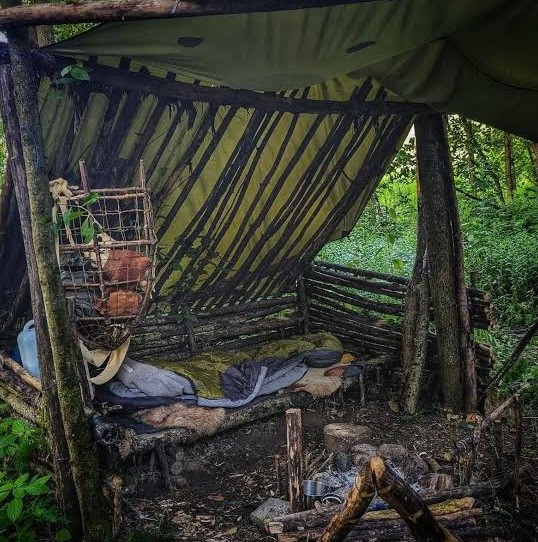
Four nights running the comparison directly, one of us on boughs and one in a second bag. The bed won every time.
| Date | Area | Low | Sky | Shelter | Heat | Edge work |
|---|---|---|---|---|---|---|
| 08 Apr | Keweenaw, MI | 31°F | Wet snow | Raised bed, flat tarp | Fire, no reflector | Bed rails, 22 cross poles |
Why does the ground take more than the air?
Contact. Air moves heat slowly by convection, but the ground is touching you and pulls it away by conduction, which is far faster.
The ground pulls heat out of you the way a cast iron pan pulls it out of a steak. It is not about the pan being cold, it is about the contact being total. Put the steak on a wire rack a half inch above the same pan and almost nothing happens, which is exactly what a bough bed does.
This is why the layer count on top is the wrong lever. A second sleeping bag adds loft above you, where the problem is not, and adds nothing underneath, where it is. Worse, the weight of your body crushes whatever insulation is under you to a fraction of its rated thickness, so the bag you are lying on is doing almost nothing.
How did the comparison run?
Four nights, two people, swapping setups each night so neither person’s tolerance skewed it. Same shelter, same fire, same clothing.
| Setup | Under-body thickness | Build or pack cost | Nights slept through | Reported cold spots |
|---|---|---|---|---|
| Bag on bare duff | 0 in | None | 0 of 4 | Hips, shoulders, back |
| Bag on 8 in spruce tips | about 3 in compressed | 35 min to gather and lay | 4 of 4 | None |
| Two bags, bare duff | about 1 in compressed | 2 lb 6 oz carried | 1 of 4 | Hips and shoulders |
| Bag on raised pole bed | 4 in air gap | 3 hrs to build | 4 of 4 | None, colder at the feet |
| Bag on closed cell pad | 0.6 in | 14 oz carried | 3 of 4 | Hips on night three |
The most useful line in that table is the third. Carrying two and a half pounds of extra bag bought one night out of four. Thirty five minutes of gathering boughs bought four out of four, and weighed nothing on the walk in.
How much thickness is worth laying
Eight inches of loose tips, which compresses to about three under a body. Past ten inches the returns fall off sharply.
- Cut tips rather than whole boughs. Tips are springy and hold air, and thick stems just create hard spots.
- Lay them shingled, cut ends down and curve up, in overlapping rows from the foot toward the head.
- Build the pile to roughly eight inches loose, then lie on it and feel for hard points before adding more.
- Add a final thin layer of fine tips at the hips and shoulders, which are the two places that compress hardest.
The measurable part is the compression. Eight inches loose settles to about three, and twelve inches loose settles to about four. That extra inch costs another twenty minutes of gathering and did not change how anyone slept on any of the four nights.
The mistake is treating the bed as a comfort item you add at the end if there is time. It is the first thing built and the last thing cut from the plan. Everything above you is negotiable.
Maren Aho, forest research field technician, Baraga County
What the raised bed adds and what it costs
It solves wet ground completely and costs three hours. That trade only makes sense when the ground is saturated or you are staying more than one night.
On 08 April the ground was slush over frozen soil, and boughs laid directly on it were wet through by midnight. The raised bed put four inches of air under the sleeper and the problem disappeared. The cost was three hours, 22 cross poles and a lot of cutting, which is a serious investment for a single night.
There is also a real drawback nobody mentions. A raised bed is colder at the feet, because air moves underneath it and the fire cannot reach that far. On both raised nights the sleeper reported cold feet and no other cold spot, which is a specific enough pattern that we now lay boughs on the platform as well rather than treating the air gap as sufficient.
The platform is the fix for water, not for cold. If it is dry underfoot, spend the three hours on wood instead and you will sleep better.
Wendell Tokarz, retired outdoor program instructor, Marquette
What this has to do with the knife
Gathering eight inches of tips for two people is a few hundred cuts in green spruce, and green spruce is the least forgiving wood on this site.
Green tips are stringy. A sharp edge shears them and a dull one bends and tears, which leaves a ragged stem that will poke through a bag by three in the morning. It is also the job most likely to be done at the end of a build when the light has gone and nobody wants to stop and strop.
- Cut tips at a shallow angle rather than square, which shears instead of crushing.
- Green spruce loads a blade with sap. Wipe it before deciding the edge has gone, for the same reason described in the feathering write-up.
- This is the one bed job where a slightly thicker grind is an advantage, because the cuts are numerous and unglamorous rather than precise.
It is a small reason among several, but it is part of why we ended up caring how a blade is ground rather than what it is called. Custom knives get made around a specific mix of work, and for anyone who builds their bed rather than carrying it, several hundred cuts in green wood belong in that mix.
- Lay the bed before the roof, always.
- Eight inches loose, then feel for hard spots before adding more.
- Boughs on top of a raised platform, not instead of them.
Where this sits in the wider structure is on camp craft, and the frame that goes over it is in ridge height and rafter spacing.