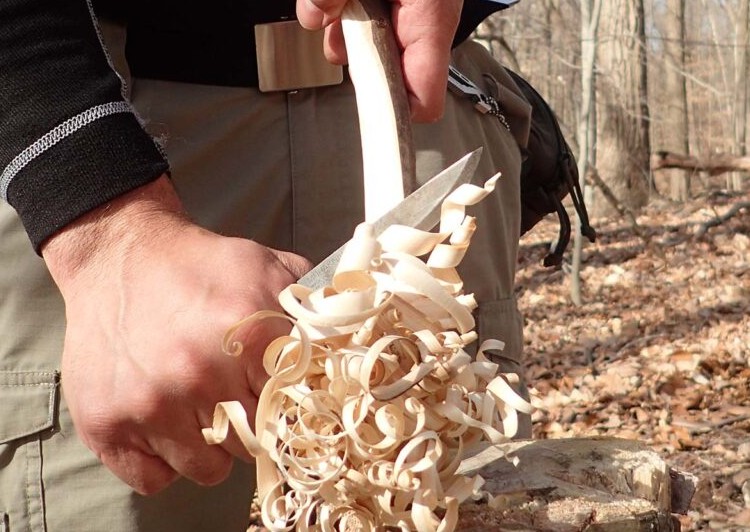
Pitch does not blunt a blade. It stops the curl letting go, which feels identical and is fixed completely differently.
| Date | Area | Low | Sky | Shelter | Heat | Edge work |
|---|---|---|---|---|---|---|
| 02 Feb | Ottawa NF, MI | -14°F | Squalls | Spruce bough A-frame | Long fire, 9 hrs | Batoned fatwood, stropped twice |
Why does a resinous stick feel like a dull knife?
Because the failure looks the same from the handle. The curl tears instead of peeling, so the hand reads it as a blunt edge when the edge is fine.
Pitch behaves on steel roughly the way wet paint behaves on a roller. It does not stop the tool working, it stops the material releasing from it, and everything downstream feels wrong in a way that is hard to name. A cleaned blade in the same stick, thirty seconds later, cuts as though it had been sharpened.
The test takes no equipment. Wipe the blade on the inside of a sleeve and take one more stroke. If the curl comes off long and clean, the problem was pitch. If it still tears, the edge is genuinely done and the strop comes out. On the 02 February camp we stropped twice, and looking back at the notes, the first of those was almost certainly unnecessary.
Which stock is worth the trouble
Resin makes wood harder to feather and much easier to light. That is the whole trade, and it decides which stick you pick up.
| Stock | Resin load | Curl quality | Strokes to a usable stick | Blade cleaning |
|---|---|---|---|---|
| Seasoned pine, standing dead | Low | Long, clean, holds shape | about 34 | Rarely |
| Spruce, standing dead, dry | Low | Good, slightly brittle | about 38 | Rarely |
| Balsam with pitch pockets | Medium | Tears at the pockets | about 55 | Every few sticks |
| Fatwood from a stump | Very high | Short and thick, will not curl | n/a | Constantly |
| Frozen hardwood | None | Splinters instead of curling | about 80 | Rarely |
Fatwood belongs in the table but not in the technique. It is a fire starter, not a feathering stock, and trying to curl it wastes both the wood and your edge. Split it into slivers with a baton and use it to bridge from spark to the pine.
What in the technique actually changes the result?
Lock the wrist, move the whole arm, and stop the stroke before the curl reaches the base. Three habits, and the third is the one nobody teaches.
- Set the stick against a solid stop at waist height. Feathering in the air produces short curls because half the force goes into moving the stick.
- Lock the wrist and drive from the shoulder. The angle has to stay constant for the length of the stroke, and wrists do not hold angles.
- Stop about an inch before the curl would separate. Attached curls catch a spark and stay put in wind; detached ones blow away.
- Rotate the stick a quarter turn every few curls, so the stick stays square and the curls stack rather than collapse.
The measurable part is the stopping. Counting across one evening, sticks cut by a student who let curls detach needed a mean of 2.4 spark attempts in a light breeze. Sticks with curls left attached needed 1.1. Same wood, same ferro rod, ten sticks each.
Everyone works on the angle and nobody works on where the stroke ends. A pile of loose shavings is not a feather stick, it is kindling that the wind is about to take away from you.
Wendell Tokarz, retired outdoor program instructor, Marquette
What this does to the edge over four nights
Feathering is roughly two thirds of all the cutting on a winter camp, so it sets the sharpening interval more than any other job.
That figure comes from the tally in the cut count, and it reframes what a camp knife is for. It is not primarily a splitting tool or a carving tool. It is a machine for producing several hundred clean release cuts in cold resinous wood, and the specification that matters is whichever one keeps those cuts releasing on the third night.
- Clean the blade before you conclude anything about sharpness.
- Expect resinous stock to cost roughly half again as many strokes per stick.
- Budget the strop for the third evening rather than for the end of the trip.
Thickness behind the edge is what governs release, and the measurements are in the grind comparison. It is also why the makers who grind custom knives one at a time ask what proportion of your work is feathering before they touch a belt: a blade set up for release and a blade set up for splitting are two different tools wearing the same silhouette.
When to give up on feathering entirely
Below about 5°F in wet snow, or when every stick on the ground has been through a thaw, feathering stops being the fastest route to a fire.
The honest alternative is to stop trying to make wet wood work and go straight to split fatwood slivers under a bark platform. It feels like cheating and it is roughly four minutes faster in bad conditions. Feathering is a technique for stock that is already dry inside, and its whole value is that it lets dry stock ignite from a spark. When there is no dry stock, the technique has nothing to work with.
- Everything on the ground has thawed and refrozen at least once.
- Curls come off grey rather than pale, which means the wood is wet through.
- You are on your third stick and still have no flame.
Knowing when to abandon a technique is worth more than being good at it. Three sticks and no flame is information, and the correct response to information is to change what you are doing.
Maren Aho, forest research field technician, Baraga County
What to reach for instead is covered in the wet ground tinder test, and the branch sits under camp craft.