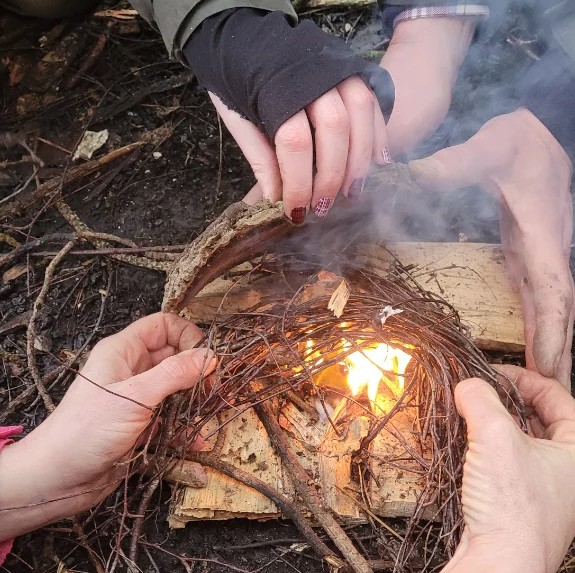
Six tinder sources, one soaked morning, timed from strike to sustained flame. Two of the six never got there.
| Date | Area | Low | Sky | Shelter | Heat | Edge work |
|---|---|---|---|---|---|---|
| 19 Mar | Baraga Co, MI | 21°F | Rain to sleet | Tarp and brush lean-to | Fire and reflector | Trench candle, drip notches |
What counts as a fair test here?
Same morning, same ferro rod, same person, everything gathered inside a hundred yard radius after eleven hours of rain turning to sleet.
Timing started at the first strike and stopped when a flame had held for sixty seconds without being fed. That sixty second rule matters. Plenty of tinder produces a spectacular flare that dies before it can pass heat to anything, and a stopwatch that stops at first flame rewards exactly the wrong behaviour.
Three attempts each, and the numbers below are the median. Where a source failed all three times it is recorded as a failure rather than given a generous best case, because on a bad morning what you want to know is what works every time.
| Source | Where it was found | Prep | Strike to sustained flame | Failures |
|---|---|---|---|---|
| Birch bark, outer curls | Standing dead birch, above knee height | None | 22 sec | 0 of 3 |
| Fatwood slivers | Split from a pine stump | Baton to matchstick | 41 sec | 0 of 3 |
| Feather stick, split core | Standing dead spruce | Split, then feather | 3 min 10 sec | 0 of 3 |
| Dead conifer twigs, snapped | Lower dead branches, off the ground | Snap test | 1 min 55 sec | 1 of 3 |
| Grass and old bird nest | Field edge | Teased into a bundle | n/a | 3 of 3 |
| Leaf litter | Forest floor | None | n/a | 3 of 3 |
Why is the ground the wrong place to look?
Anything lying on the forest floor has been wicking water for as long as it has been raining. Height above the ground predicts dryness better than species does.
This is the single most useful pattern in the table. The two total failures were both collected off the floor. Everything that worked came from standing dead wood, from a stump that shed water, or from branches still attached above knee height. In the plot work we measure moisture in downed material routinely, and after a long rain the difference between a stick lying in the duff and the same species still standing is not subtle.
The mental model that helps is a sponge in a sink. It does not matter what the sponge is made of. What matters is whether it has been sitting in the water, and a forest floor after eleven hours of rain is a sink.
The floor looks like the obvious place because that is where wood collects. It is also the only place in the forest that is guaranteed wet. Look up, not down, and snap rather than bend to test.
Maren Aho, forest research field technician, Baraga County
The order to work through
Four steps, and the whole point is that you commit to the next one quickly rather than grinding at a source that is not going to light.
- Look for standing dead birch first. Outer bark curls carry their own oil and light wet, which nothing else on the list does.
- If there is no birch, find a pine stump and split fatwood out of the heart.
- If there is neither, take standing dead spruce, split it, and feather the dry core.
- Give any source three honest attempts, then move on. A fourth attempt on wet tinder costs more than walking another fifty yards.
On the 19 March build we spent nine minutes on damp conifer twigs before switching to birch, which then took twenty two seconds. The nine minutes were not spent learning anything. They were spent being unwilling to admit the first choice was wrong.
What the knife does in wet conditions
It gets you inside the wood. In the wet the interior of a standing dead stick is the only dry material available, and only a blade opens it.
That reframes the whole role of the knife on a wet trip. Splitting to reach a dry core, then feathering that core, is the entire fire routine when there is no birch. Both jobs are described in the feathering write-up, and both are made harder by an edge that has been skating since yesterday.
- Split first, always. The outside of the stick tells you nothing about the inside.
- Feather from the split face, not from the bark side.
- Cut a shallow trench in a larger split to hold the tinder off wet ground while it takes.
This is also the practical reason we care about blade geometry rather than steel names. A knife that still releases a clean curl on a cold wet third morning is worth more than any specification on a box, which is what pushed us toward custom knives ground for the wood we actually cut.
What the test cannot tell you
One morning, one forest and one set of species. The ranking is ours, and parts of it will not travel.
- There is no birch in large parts of the country. Where there is none, the first step of the sequence is simply unavailable.
- Our rain was cold. Warm wet conditions dry differently and grass bundles that failed here can work well elsewhere.
- Three attempts is a small sample. Treat the failures as reliable and the exact seconds as approximate.
A number from one morning is a starting point, not a rule. The part I would carry anywhere is the height rule. The seconds belong to that specific sleet.
Wendell Tokarz, retired outdoor program instructor, Marquette
The rest of the fire branch sits under camp craft.