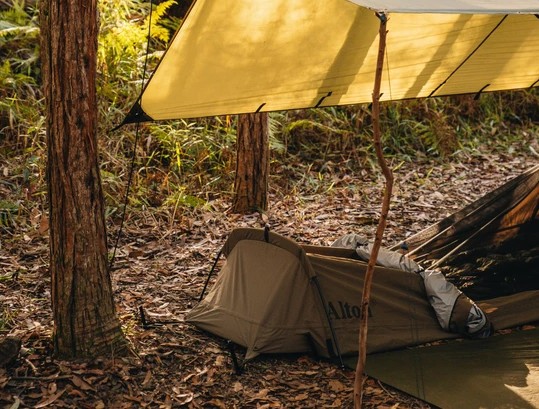
Drainage first, deadfall overhead second, wind third. Every bad night we have had came from taking those in the wrong order.
| Date | Area | Low | Sky | Shelter | Heat | Edge work |
|---|---|---|---|---|---|---|
| 08 Apr | Keweenaw, MI | 31°F | Wet snow | Raised bed, flat tarp | Fire, no reflector | Bed rails, 22 cross poles |
Why is drainage the first question?
Because it is the only one you cannot fix after the shelter is up. Wind can be screened and a dead branch can be avoided. Water that runs where you sleep just runs.
The mistake is easy to make because water is not moving when you choose the site. A shallow depression in April looks like a sheltered flat spot, and at two in the morning it is the low point of everything uphill of it. That is exactly what happened to us on 08 April: dry-looking ground, wet snow overnight, and meltwater tracking under the bedding from above.
Reading ground for drainage takes about a minute and it is mostly about looking uphill rather than at your feet. Where would water arriving from up there go? If the answer involves your bed, move twenty feet. Twenty feet is almost always enough, which is why this mistake is so annoying in hindsight.
- Look for a slight crown or a bench rather than a flat, and never a hollow.
- Old leaf litter piled in a line is a watermark. Something ran there before.
- Bright green moss and soft ground mean water sits there routinely.
- In snow, dig down. A drift can hide a drainage channel completely.
What is overhead
Standing dead limbs are the quiet danger in this kind of camping, and the one people genuinely die from.
Anything dead above you can come down, and the ones that do it are almost always hanging branches already broken loose and caught in the canopy, rather than whole trees. They come down with wind, with a thaw, or with nothing obvious at all. The check is thirty seconds with a headlamp: stand where the bed will be, look straight up, and move if anything up there is dead, broken or leaning.
It also rules out the most attractive campsites. A big old tree with a clear floor beneath it is inviting for the same reason it is dangerous, which is that it has been shedding limbs onto that floor for years.
| Site type | Drainage | Overhead risk | Wind | Verdict |
|---|---|---|---|---|
| Slight bench or crown | Sheds water | Depends on canopy | Often breezy | First choice every time |
| Flat hollow, sheltered | Collects water | Usually low | Still air | The trap. Looks best, sleeps worst |
| Under a large old tree | Usually good | High, sheds limbs | Low | Refuse it, however inviting the floor looks |
| Conifer stand, dense | Mixed, needle duff drains well | Moderate | Low | Good if the ground is not compacted wet |
| Open cut or clearing edge | Good | Low | Highest exposure | Workable with a wind screen, cold otherwise |
| Streamside flat | Worst, rises without warning | Moderate | Channelled | Never, regardless of how dry it looks |
Look up before you look around. Students pick the spot at eye level, and eye level tells you nothing about what is fifty feet above your head waiting for a thaw.
Maren Aho, forest research field technician, Baraga County
Wind, and which way to face the opening
Face the open side away from the prevailing wind and toward the fire. If those two conflict, move the fire, not the shelter.
A tarp lean-to is a wing. Pitched with its back to the wind it is stable and it holds heat against the bed. Pitched with its open face into the wind it lifts, and on a bad night it will lift hard enough to pull a stake. Reading prevailing wind in a forest is unreliable at ground level, so look at how the canopy leans and at where snow has drifted, which are the accumulated record of what the wind has actually been doing.
The trade to be aware of is that the most sheltered pockets are often the wettest, because still air and low ground go together. Given a choice between a damp hollow out of the wind and a dry bench with a breeze, take the bench and build a wind screen. You can add a screen. You cannot drain a hollow.
What order should you check these in?
Four checks, in this sequence, and the whole thing takes about five minutes.
- Walk uphill of the spot and work out where water would arrive from and where it would go.
- Stand on the bed position and look straight up for anything dead, hanging or leaning.
- Read the canopy lean and the drift lines for prevailing wind, then set the back of the shelter to it.
- Only then check for straight anchors, level ground and whether the material you need is within a short carry.
Doing it in this order matters because each check can veto the site, and the cheap vetoes come first. There is no point measuring anchor spacing on ground you are about to abandon because there is a hung limb over it.
- Two trees at a workable spacing are convenient, not essential. A ridge line can run to a single tree and a cut pole.
- Standing dead material within about a hundred yards decides your build time more than anything about the site itself.
- Mark where the drip line will fall before the tarp goes up, which is covered in ridge height and rafter spacing.
The hollow gets chosen because it feels protected, and feeling protected is not the same as being dry. I have never regretted taking the windy bench and I have regretted the hollow twice.
Wendell Tokarz, retired outdoor program instructor, Marquette
Once the site is chosen, the build order is the same every time and it is set out on camp craft. What goes under you once the tarp is up is in spruce tips or a second sleeping bag.