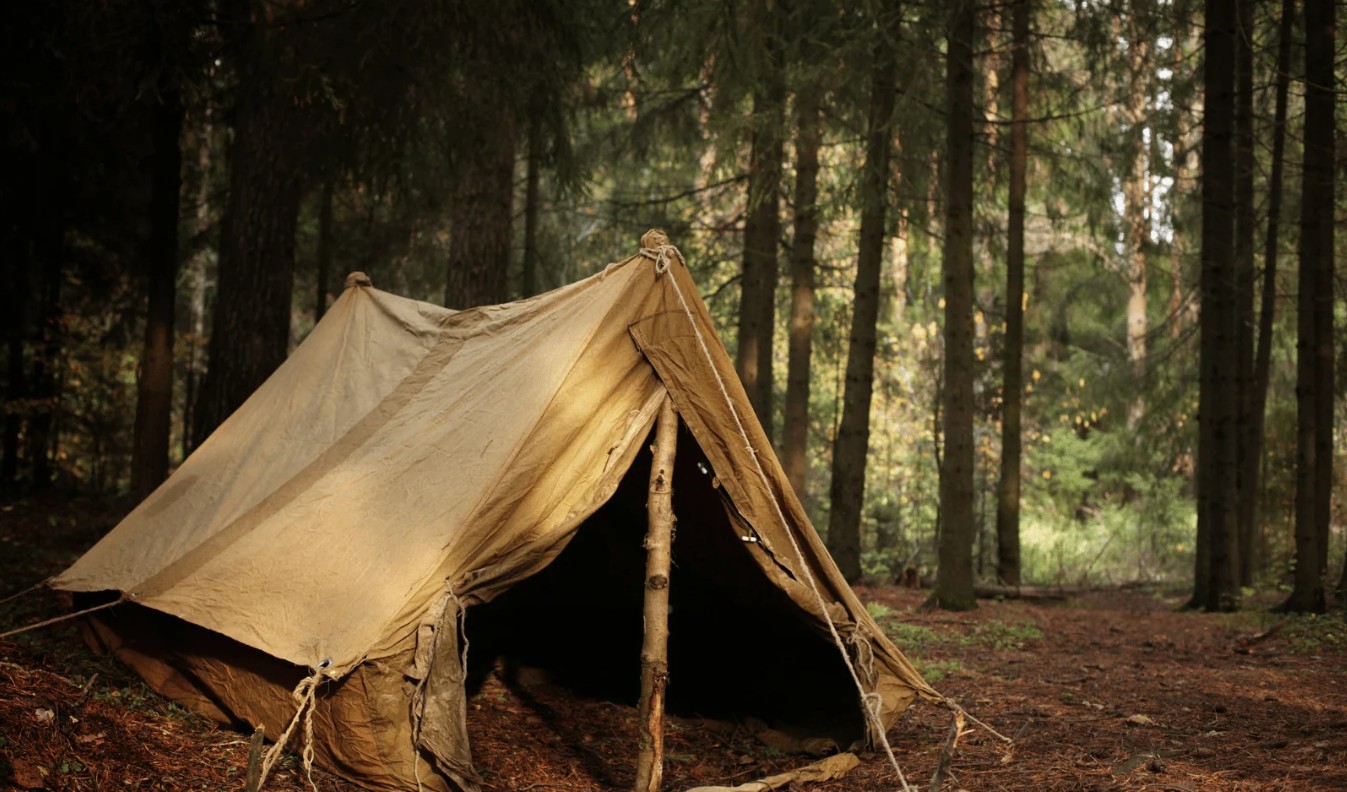
A stove inside a tent buys twenty to thirty degrees. It costs fourteen pounds, forty minutes of setup and getting up twice in the night.
| Date | Area | Low | Sky | Shelter | Heat | Edge work |
|---|---|---|---|---|---|---|
| 27 Feb | Iron Co, WI | 3°F | Overcast | Hot tent, stove jack | Box stove, fed twice | Pot hanger, eight tent stakes |
What does a stove jack actually change?
It moves the fire from outside the shelter to inside it. Everything good and everything bad about a hot tent follows from that one move.
A stove jack is a heat-resistant port in the tent wall or roof that lets a flue pass through without setting the fabric alight. That is the whole technology. The consequences are large: you get a dry, warm interior you can stand up in and dry gear in, and you take on a fuel schedule, a carbon monoxide risk and a lot of weight.
Across eight nights with a stove tent, the interior sat 20°F to 30°F above ambient while the stove was running, and dropped back to within about 5°F of outside within forty minutes of the fire going out. That second number is the one people underestimate. A hot tent is not insulated. It is heated, and heating stops when you fall asleep.
What eight nights actually cost
Fourteen pounds carried, forty minutes of setup, and two wake-ups a night to feed the box. Every one of those is a real price, not a footnote.
| Measure | Hot tent with box stove | Built shelter with outside fire |
|---|---|---|
| Weight carried | about 14 lb for tent and stove | about 2 lb for a tarp |
| Time to habitable | 40 min pitch and set flue | 50 min to 3 hrs to build |
| Interior over ambient, running | 20°F to 30°F | 8°F to 12°F at the bed |
| Interior over ambient, fire out | about 5°F | about 5°F |
| Wake-ups to feed | 2 per night | 1 or none with a long fire |
| Dries wet gear overnight | Yes, reliably | Partly, and only near the fire |
| Nights on our sheet | 8 | 41 |
The honest summary is that a hot tent buys comfort and costs autonomy. You can dry boots and sit upright in a shirt at 3°F, which nothing you build will match. You also carry the shelter in rather than making it from what is standing, and you commit to a fuel routine that runs all night.
When is it worth the weight?
Three cases. A base camp you return to, several nights below 20°F, or any trip where wet gear has to be dry by morning.
- Are you staying put? A stove pays back over multiple nights and is dead weight on a one night trip.
- Is the low under 20°F? Above that, a built shelter with a fire and a reflector does enough, as covered in ridge height and rafter spacing.
- Will anything be wet? Drying is the one job a stove does that nothing else does.
- Can somebody wake up twice? If everyone in the party sleeps hard, the stove is cold by two in the morning and you carried it for nothing.
The stove is not a substitute for the bed. People buy one, sleep on bare groundsheet because the air is warm, and then wonder why their hips are cold. The ground does not care what the air temperature is.
Maren Aho, forest research field technician, Baraga County
The safety part, which is not optional
A stove inside fabric is an open flame in a confined space. Carbon monoxide is colourless, has no smell, and kills people in tents every winter.
- Carry a battery carbon monoxide detector and put it at head height, not on the floor. It is the single cheapest piece of safety equipment in this kind of camping.
- Check the flue seating every time. Most incidents trace to a joint that worked loose as the pipe expanded rather than to the stove itself.
- Keep a vent open at both low and high points. A sealed tent with a running stove is the dangerous configuration.
The jack is the part that ages, not the stove. Heat cycles work at that seam every trip, and it is the one thing on the whole shelter I check with my hands before every cold night.
Wendell Tokarz, retired outdoor program instructor, Marquette
Sparks are the other risk and the more visible one. A flue throws embers, and synthetic fabric takes a pinhole from an ember instantly. That single fact drives most of the material choice, which is why it gets its own write-up in canvas or synthetic.
What it does to the rest of your kit
It shifts work from the knife to the saw, and it changes what wood you want. That is a bigger change to a camp routine than it sounds.
An outside fire runs on split standing dead and a lot of feather sticks. A box stove runs on short lengths cut to fit the firebox, which is saw work rather than knife work. Over eight nights the tally shifted noticeably: fewer feather sticks, far more crosscuts, and the axe suddenly earned its weight because the stove wanted split wood at a steady rate.
- Measure your firebox and cut to that length. Wood that will not fit is wood you carried for nothing.
- A stove is hungrier than it looks. Budget roughly twice the wood a reflector fire needs for the same hours.
- Bring the saw. This is the one configuration where leaving it behind is a mistake, for the reasons set out in knife, axe or saw.
Where this sits alongside everything else is on camp craft.