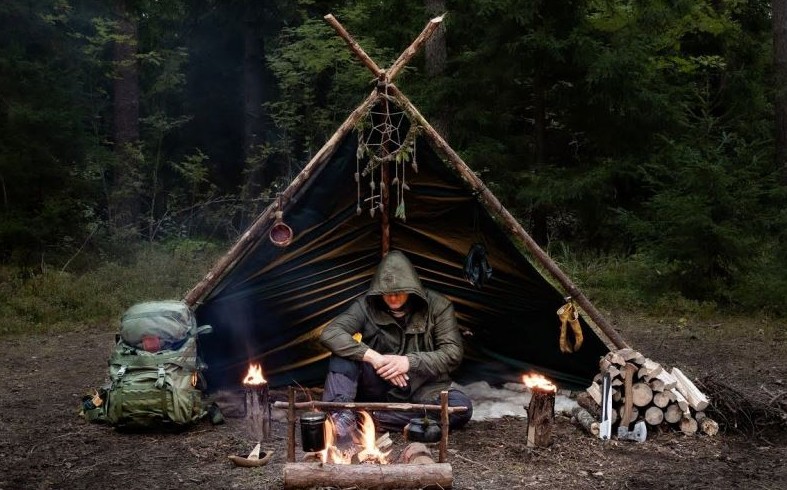
Firebox volume decides how often you get up in the night. Weight, material and price decide almost nothing by comparison.
| Date | Area | Low | Sky | Shelter | Heat | Edge work |
|---|---|---|---|---|---|---|
| 27 Feb | Iron Co, WI | 3°F | Overcast | Hot tent, stove jack | Box stove, fed twice | Pot hanger, eight tent stakes |
Which number should you actually compare?
Firebox volume. It sets burn time, and burn time is the only specification that changes what the night feels like.
Every other figure on a product page is a proxy for something. Firebox volume is the thing itself: a box that holds more wood burns longer before it needs feeding, and how long that is decides whether you sleep through or get up twice. Across eight nights the pattern held without exception. A small box wanted feeding roughly every two hours. A larger one stretched to three and a half.
Material gets discussed far more than it deserves. Titanium is lighter and warps and cools fast. Steel is heavier, holds shape and holds heat after the fire dies. Neither one changes the fundamental problem, which is that a stove burning at a rate that keeps you warm consumes wood at a rate that wakes you up.
| Property | Small firebox | Large firebox | What it means at 03:00 |
|---|---|---|---|
| Burn time between feeds | about 2 hrs | about 3.5 hrs | Two wake-ups instead of three |
| Weight | 5 to 8 lb | 10 to 16 lb | Only matters on foot |
| Wood prep | Short splits, frequent | Longer splits, less often | More saw work either way |
| Heat output while running | Adequate to about 10°F | Comfortable below 0°F | Decides whether you sleep clothed |
| Titanium body | Lightest, warps over seasons | Rare at this size | Cools within minutes of the fire dying |
| Steel body | Heavier, stable | Standard | Radiates for 20 to 30 min after |
Why does the damper matter more than the stove?
Air control is what converts firebox volume into burn time. A stove run wide open burns its load in under an hour regardless of how big it is.
This is the single most common mistake we saw in student camps, and it is completely invisible if nobody points it out. Somebody loads the box, opens everything up because the fire looks weak, gets a roaring stove and a warm tent, and is out of wood by midnight. Throttling back once the load is caught turns the same wood into three times the hours.
A stove damper is a throttle and behaves like one. Nobody drives a long journey at full throttle and then complains about the fuel stops, but that is precisely what a wide open stove is doing.
Load it, catch it, then shut it down to about a third. If you can hear it roaring you are burning tomorrow morning’s wood tonight, and you will find that out at the worst possible time.
Wendell Tokarz, retired outdoor program instructor, Marquette
Cleaning the flue, and why it is a safety job
A partly blocked flue does not stop drawing. It draws worse, and the difference goes into the tent as smoke and carbon monoxide.
- Break the pipe down after every trip and look through each section against the sky. Any section you cannot see daylight through needs cleaning before it goes back in a tent.
- Run a stiff brush or a rag on a stick through each section. Creosote comes off dry and black, and there is always more than you expect.
- Check the spark arrestor separately. It clogs first because it has the smallest openings.
- Inspect the joints for warping. A joint that no longer seats tight is the most common source of an indoor leak.
Hold a pipe section up and look through it at the sky. If you cannot see daylight, it does not go back in a tent. That test needs no equipment and it has never once failed to tell me something.
Maren Aho, forest research field technician, Baraga County
Creosote builds fastest on unseasoned or resinous wood burned at low temperature, which is exactly what a throttled stove running on standing dead spruce produces. The two habits that keep a tent warm are the same two that dirty a flue, so the cleaning is not optional maintenance, it is part of the cost of the method.
What the stove asks of your wood and your tools
Short, split, and a lot of it. A stove eats roughly twice what a reflector fire needs for the same hours.
- Measure the firebox and cut every piece to that length. Wood that does not fit is weight you carried and cannot burn.
- Split more than feels necessary. Round stock smoulders in a throttled box and that is where creosote comes from.
- Bring the saw. Stove length wood is crosscut work, not batoning work.
This is the one camp configuration where the axe clearly earns its weight, which reverses the usual finding in knife, axe or saw. The knife’s role shrinks to lighting the thing, which is still a feathering job every single morning.
- Two hours of burn per feed is realistic for a small box, not a marketing figure.
- A titanium box is cold within minutes of the fire dying. Plan the last load accordingly.
- Dry your kindling for the morning inside the tent overnight. It is the one free thing a stove gives you.
The shelter side of this is in hot tents with a stove jack, and the structure it all sits in is camp craft.